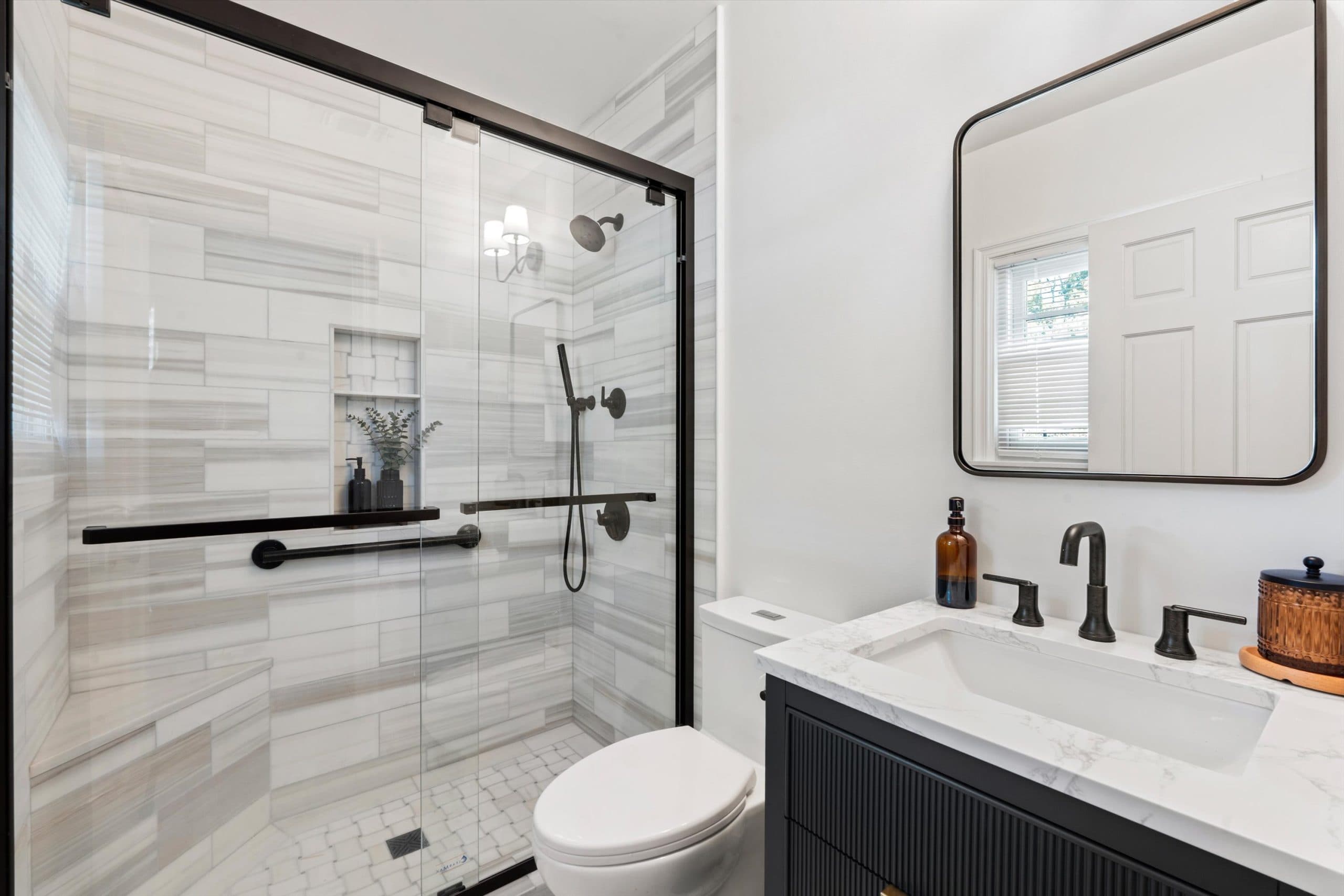

Heated floors come up in almost every bathroom remodel conversation we have. Homeowners love the idea — until they try to figure out what it actually costs, and find wildly inconsistent numbers online ranging from $500 to $10,000 for the same size bathroom.
Here’s a straightforward breakdown from a contractor who installs these systems in Sacramento homes regularly.
The Short Answer
For a typical Sacramento master bathroom with 50–80 square feet of tile floor, expect electric radiant floor heating to add $1,210–$2,140 to your bathroom remodel cost, fully installed. That number includes materials, labor, and electrical rough-in.
As a standalone project — adding heated floors to an existing bathroom without other remodel work — costs run higher, typically $2,500–$4,500, because you’re paying for tile demolition, reinstallation, and mobilization separately.
Full Cost Breakdown
Here’s how the numbers stack up for a 60 sq ft bathroom — a common size for Sacramento master baths:
Materials
| Item | Cost Range |
|---|---|
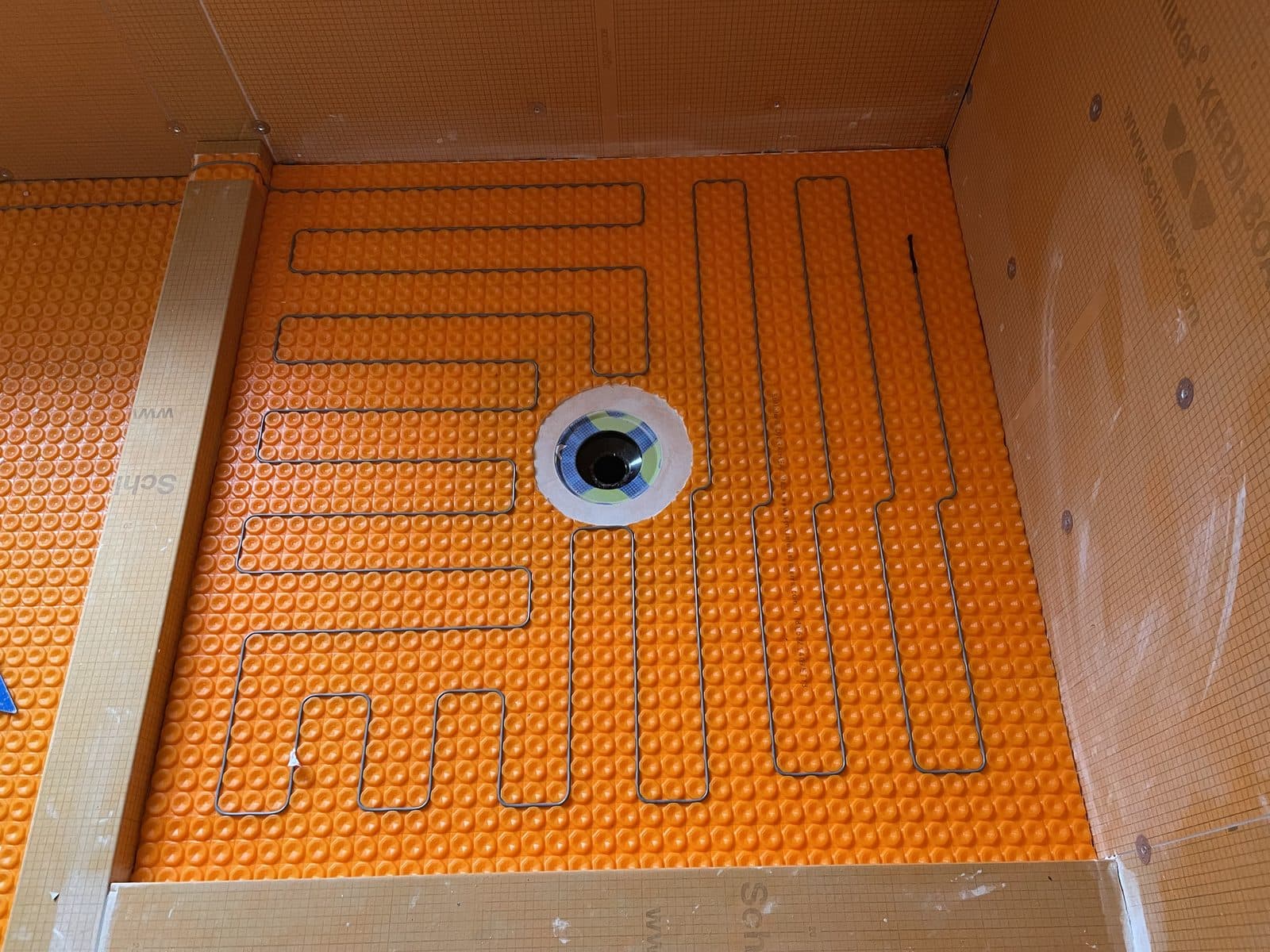
| DITRA-HEAT uncoupling/heating membrane (60 sq ft) | $150–$220 |
| Heating cable (sized for 60 sq ft coverage) | $180–$300 |
| Programmable Wi-Fi thermostat | $150–$220 |
| Materials subtotal | $480–$740 |
Labor
| Item | Cost Range |
|---|---|
| Membrane and cable installation | $400–$650 |
| Thermostat installation | $80–$150 |
| Electrician — dedicated 20-amp circuit | $250–$600 |
| Labor subtotal | $730–$1,400 |
Total Installed (60 sq ft, within a bathroom remodel)
$1,210–$2,140
That is simply the two subtotals above added together. Note what sits inside it: the thermostat, its installation, and the electrician’s dedicated circuit come to $480–$970 before a single square foot of membrane goes down. Those costs are the same whether the floor is 20 sq ft or 150, which is why a small heated floor costs more per square foot than a large one.
What doesn't scale
The part that costs the same at any size
Installed within a bathroom remodel — what grows with the floor, and what doesn't
The thermostat, its installation and the dedicated circuit come to $480–$970 before a single square foot of membrane goes down. A 40 sq ft powder room pays that in full, which is why small floors cost more per square foot than large ones.
Parrish Construction line-item costing, 2026. Fixed and per-sq-ft components derived from the materials and labour breakdown in this post.
What Moves the Number Up or Down
Subfloor condition
If your subfloor has soft spots, uneven areas, or needs patching before the membrane goes down, that adds time and cost. We always assess subfloor condition during the estimate — this is the most common source of unexpected cost in heated floor projects.
Electrical panel capacity
A dedicated 20-amp circuit is required for the heating system. If your panel has available capacity, a licensed electrician can run the circuit for $250–$400. If your panel is near capacity or needs an upgrade, that cost can jump significantly — sometimes into the $800–$1,500 range for the electrical work alone. We flag this early so it doesn’t catch you off guard at project end.
Room size
Larger rooms see better per-square-foot economics on materials, but labor costs scale too. Ballpark totals by room size:
| Room Size | Estimated Installed Cost (within remodel) | Works out to |
|---|---|---|
| 40 sq ft (small bath) | $970–$1,750 | ~$34/sq ft |
| 60 sq ft (typical primary) | $1,210–$2,140 | ~$28/sq ft |
| 80 sq ft (larger primary) | $1,450–$2,530 | ~$25/sq ft |
| 100 sq ft | $1,700–$2,920 | ~$23/sq ft |
The per-square-foot number falls as the floor gets bigger — that’s the fixed block above spreading across more area, not a volume discount.
Standalone vs. within a remodel
This is the biggest cost variable. When heated floors are part of a full bathroom remodel, we’re already removing tile, preparing the subfloor, and installing a new tile assembly — so adding the heating membrane and cables is a natural extension of work already underway. The incremental cost is relatively low.
If you want heated floors added to an existing bathroom without other work, you’re paying for tile demolition, disposal, subfloor prep, heated floor installation, new tile materials, and tile reinstallation — essentially a full floor replacement plus the heating system. Costs for a standalone heated floor addition typically run $2,500–$4,500 for the same 60 sq ft bathroom.
Operating Costs: What It Adds to Your Electric Bill
This is where most online estimates fall apart, because the answer depends heavily on which utility you’re on — and in the Sacramento region that varies a lot from one suburb to the next.
DITRA-HEAT draws roughly 12 watts per square foot of heated area. A 60 sq ft bathroom is about 720 watts, or 0.72 kW at full draw.
Here’s what that costs to run across the three utilities that serve our market:
The utility gap
The same floor, on three utilities
60 sq ft of heated tile, 2 hours a day — monthly cost to run
PG&E customers pay about 2.7× what SMUD customers pay to run the identical floor. A calculator using a national average rate cannot tell you that.
Parrish Construction model — Schluter DITRA-HEAT at 12 W/sq ft, thermostat cycling at 70% duty for the low end. Utility figures are residential averages as of September 2026.
| Utility | Approx. residential rate | 1 hr/day | 2 hrs/day |
|---|---|---|---|
| SMUD (Sacramento County — Carmichael, Sacramento, Folsom) | ~14.5¢/kWh | ~$3/month | ~$6/month |
| Roseville Electric (City of Roseville) | ~20¢/kWh | ~$4/month | ~$9/month |
| PG&E (El Dorado Hills, much of Placer County) | ~39¢/kWh | ~$9/month | ~$17/month |
Two things worth knowing about those numbers:
They’re the ceiling, not the average. The figures above assume the cable pulls full power for the entire time it’s on. In practice, once the floor reaches its setpoint the thermostat cycles the cable off and on to hold temperature — so actual consumption typically lands below these estimates.
Leaving it on all day is the expensive mistake. Running a 60 sq ft system continuously costs roughly $75/month on SMUD and over $200/month on PG&E. Nobody should do this. With a programmable thermostat set to pre-heat for 45 minutes before your morning routine and shut off afterward, you get the entire benefit for a few dollars a month.
If you’re in SMUD territory — which covers most of our Sacramento County work — heated floors are genuinely cheap to operate. If you’re in El Dorado Hills or another PG&E area, the running cost is meaningfully higher and worth factoring into the decision.
Rates cited are approximate residential averages as of September 2026 and change periodically. Check your current rate schedule with your utility for exact figures.
Want the number for your bathroom rather than ours? Run our heated floor cost calculator — set your tile area, pick your utility, and choose how many hours a day you’d actually run it. It prices both the installation and the monthly operating cost, and it takes about thirty seconds. No email required.
Is It Worth the Cost?
That depends on how you’re weighing it. From a pure comfort standpoint — stepping onto a warm tile floor on a January morning in Sacramento — the answer is almost universally yes.
For context: most full bathroom gut-and-rebuilds in our market land between $21,000 and $40,000. Adding $1,500 for heated floors is roughly 4–7% of the project for a feature you’ll use every single day.
Free Download — 2026 Sacramento Kitchen & Bath Cost Guide
Real pricing data for homeowners planning a remodel in Sacramento. Cost ranges by project tier, a budget breakdown, and the questions you should ask before signing with any contractor. Enter your details below and we'll email it to you.
No spam. Unsubscribe anytime.
Getting an Accurate Number for Your Project
The estimates above are solid starting points, but your actual cost depends on your specific subfloor, electrical panel, and bathroom layout. The best way to get a real number is a project estimate.
If you want to narrow the range yourself first, the heated floor cost calculator will price your specific tile area and utility in about thirty seconds.
We assess heated floor feasibility and cost as part of every bathroom remodel estimate — no separate trip, no extra charge for the assessment.